The Polus mastery platform

Build Mastery. Verify It. Keep It Strong

Mastery Realm connects learning, adaptive practice, timely support, continuous evidence, mastery certification, and long-term maintenance in one system. It begins with Polus Arithmetic Foundations for learners ages 8–16.

In development and preparing for pilot testing with the K–8 Arithmetic Foundations curriculum.

Product pathwayK–8 math first
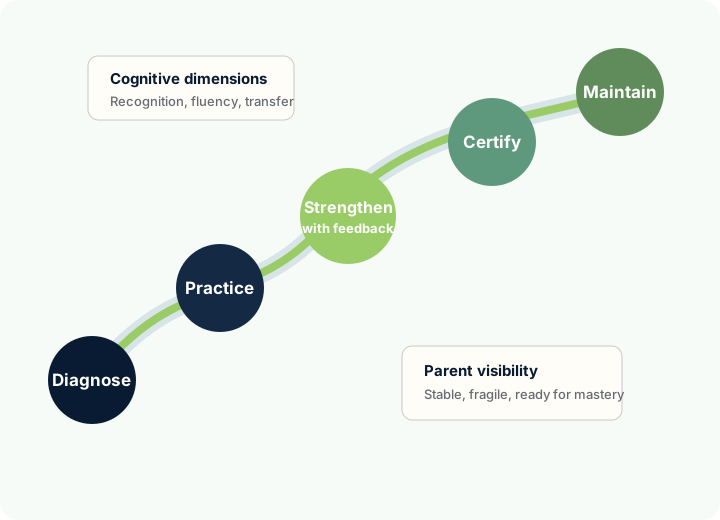
Mastery Realm map showing diagnosis, practice, feedback, mastery certification, and maintenance.
Arithmetic FoundationsDefines what must be understood
Mastery RealmDetermines whether it has been learned
One continuous loopLearn, practice, support, certify, maintain

Why it exists

A Child Can Work Hard and Still Have Hidden Gaps

A child may remember a procedure long enough to finish an assignment without understanding the earlier ideas that make the procedure meaningful. Traditional pacing often moves on because the work is complete or the answer is correct.

Mastery Realm exists to reveal those hidden gaps, connect each learner to the right part of the Polus curriculum, and gather enough evidence to know when understanding is ready to trust.

What families gain

From Confusion to a Clear Next Step

Each part of the system answers a practical question for the student and parent.

Find the Real Starting Point

Shows what the student already understands and which earlier skill is making current work harder.

Practice What Matters Next

Uses the student's work to choose the next concept and level, reducing practice that is too easy, too hard, or unrelated.

Build Independence Carefully

Offers explanations, examples, hints, and feedback while learning, then reduces support as understanding grows.

Know Whether Learning Lasts

Returns to ideas later and in new forms so families can distinguish temporary success from dependable mastery.

Why traditional approaches fall short

Why Correct Answers Are Not Always Mastery

Correctness matters, but one correct answer may come from imitation, a hint, or a familiar-looking problem. Mastery asks what the student can still explain and use when the support and surface pattern change.

Completion-focused approachMastery Realm
Records that a lesson was finishedLooks for evidence that the idea is understood
Assigns work mainly by age or gradeStarts from the earlier skills the student is ready to build on
May reward speed, streaks, or volumeValues explanation, independence, transfer, and retention
Moves on after familiar correct answersChecks whether the student can handle changed and unfamiliar problems
Shows a scoreAims to show what is secure, fragile, or still being repaired

What mastery looks like

What Durable Understanding Looks Like

A student does not need to know these technical categories. They help the system look beyond a single score and ask whether the student can recognize, explain, use, connect, and judge an idea. See the learning science behind the system.

Recognize the Idea

Can the student tell what kind of problem or concept they are seeing?

Recognition and classification

Explain What It Means

Can the student describe the idea accurately instead of repeating a memorized phrase?

Definition precision

Use the Method

Can the student carry out the procedure accurately and with growing fluency?

Procedural fluency

See the Connections

Can the student explain how this idea depends on or relates to other math?

Relational understanding

Apply It Somewhere New

Can the student use the idea when the wording, context, or problem form changes?

Transfer and application

Know What They Know

Can the student judge when they are confident, uncertain, or need help?

Self-checking and calibration

The student journey

Support Should Fade as Independence Grows

The goal is not to make work permanently easier. It is to give enough support to build understanding, then see whether the student can succeed without it.

Find the Starting Point

Identify what is already secure and where the first useful repair should begin.

Calibration

Learn with Support

Use examples, feedback, questions, and hints to build the missing connection.

Learning

Show Independent Understanding

Work without learning supports so mastery evidence is meaningful.

Mastery

Keep It Strong

Return to the idea later so forgotten learning does not become another hidden gap.

Maintenance

Why Arithmetic Foundations comes first

Why K–8 Foundations Come First

Fractions affect ratios. Ratios affect proportional reasoning. Arithmetic fluency affects equations and algebra. When one foundation is fragile, the difficulty may not appear until years later.

Polus Arithmetic Foundations supplies the first connected curriculum for Mastery Realm because these relationships support more than later coursework. Mathematics helps learners describe patterns, structure information, model relationships, reason about change, make predictions, and communicate quantitative ideas about the world. See the eight curriculum domains.

Pilot access

Mastery Realm Is Preparing for Pilot Testing

Join the waitlist for updates as Polus builds a clearer standard for stable understanding across time, variation, and unfamiliar problems.

Join the Mastery Realm Waitlist