
Focus attention
Prompts help the student notice the part of the problem that matters.
How it works
Student work becomes evidence: what is known, what is fragile, and what should happen next.
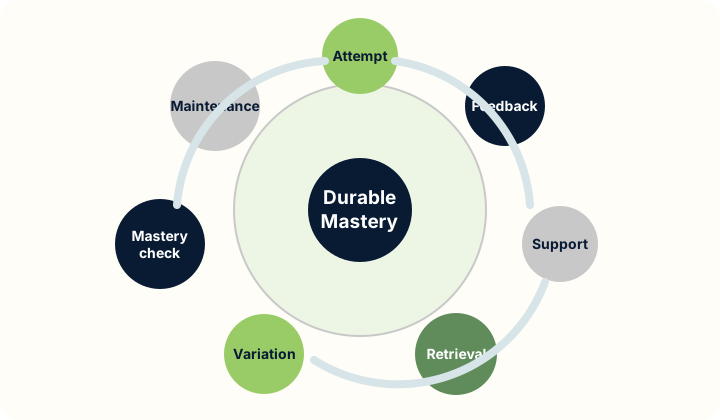
Loop
Practice alone is not the product. The value comes from what the system learns and how the next step changes.
A problem matched to readiness reveals what the student can do independently.
Fast feedback keeps a small misconception from becoming a repeated habit.
Examples, hints, and questions help the student make the next thinking move without simply receiving the answer.
Bringing the idea back from memory makes it easier to use later without prompting.
Changed problems show whether the student learned the idea or copied a pattern.
Later review protects learning from quietly fading.
Support
A hint can produce a correct answer without producing mastery. Support is useful when it helps the student take the next thinking step.
Prompts help the student notice the part of the problem that matters.
Scaffolds break a challenge into useful decisions without doing the thinking.
Worked examples give students a model before unfamiliar work.
Questions help students explain relationships and notice where reasoning changed direction.
Feedback helps students revise before the wrong approach becomes familiar.
Support reduces as the student becomes ready to explain and apply the idea alone.
Variation
Students need varied examples, different answer modes, and transfer tasks. Variation helps them decide which method fits instead of copying the last problem.
For example, a student who can solve 24 divided by 6 should also recognize the same relationship in an array, a word problem, or a missing-factor equation.
Signals
Was the answer correct?
Does the work show a path?
Could the student proceed alone?
Does it remain available later?
Can the idea work in a new form?
Can the student notice when the work needs another look?
Next step