Mastery Realm + Polus Arithmetic Foundations

Replace Grades and Guesswork with Mastery

Polus Education is building Mastery Realm, a platform that connects guided learning, practice, support, evidence, certification, and review. Its first curriculum, Polus Arithmetic Foundations, starts with the K–8 math students need before formal algebra.

In development for learners ages 8–16 and preparing for pilot testing. No purchase or tutoring appointment is currently offered.

Continuous mastery systemEvidence over guesswork
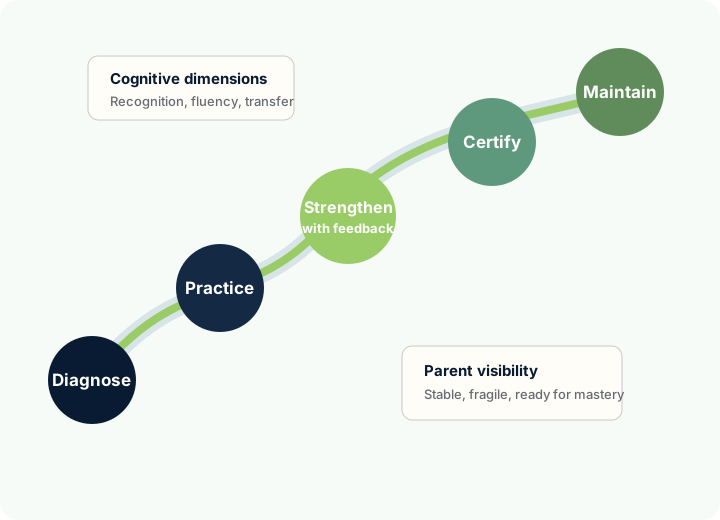
Connected progression from learning and practice through support, evidence, certification, and maintenance.

Every response helps reveal what is secure, what is fragile, and what the learner should strengthen next.

Polus EducationThe parent brand and mastery philosophy
Mastery RealmThe platform that builds and verifies mastery
Arithmetic FoundationsThe first complete Polus curriculum

The problem

Why Correct Answers Are Not Always Mastery

A quiz can show what a student produced that day. It may not show whether earlier foundations are secure or whether the learning will still be there next month. A student might know the steps for subtraction but struggle when the same idea appears in a word problem, on a number line, or in a missing-value equation.

The disconnected cycle

  1. Teach a lesson
  2. Assign homework
  3. Give a quiz or test
  4. Record a grade
  5. Move on
  6. Hidden gaps remain

The Polus mastery cycle

  1. Learn
  2. Practice
  3. Receive the right support
  4. Build continuous evidence
  5. Certify mastery
  6. Maintain it over time
Correct answers are not always mastery. Hidden gaps should be visible and repairable.

A complete mastery system

How Mastery Realm Works

Mastery Realm connects parts of learning that are usually separated. What a student does in practice changes the support they receive and the evidence used to decide what comes next.

01

Learn

Encounter a concept through clear explanations, examples, and connected representations.

02

Practice

Work with varied problems that reveal reasoning, not just repetition.

03

Support

Receive hints and guidance matched to the learner's specific obstacle.

04

Evidence

Build a fuller picture across accuracy, reasoning, transfer, and time.

05

Certify

Students move forward when their foundations are stable and the evidence supports independent understanding.

06

Maintain

Revisit important ideas before they fade or become future barriers.

Polus is not built around speed, streaks, homework answers, or an AI bot doing the thinking. It is built around whether a student's understanding is strong enough to last.

Useful evidence for the adults who support learning

What Parents and Teachers Can See

For parents

Know What Your Child Understands

  • See which foundations are strong, fragile, or missing.
  • Understand why a learner is stuck and what comes next.
  • Distinguish short-term performance from lasting mastery.
  • Follow progress without needing to interpret learning-science jargon.
See the parent experience

For teachers

Use Practice as Evidence

  • See prerequisite gaps before they derail new instruction.
  • Use everyday practice as evidence instead of adding another test.
  • Identify who needs intervention and what kind of support fits.
  • Spend less time repeating broad review when the actual gap is specific.
See the educator roadmap

For schools, co-ops, and learning programs

A Practical Path for Schools and Learning Programs

Polus is not claiming to replace a school's grading or accreditation system today. The practical path begins with focused foundational support and expands as the platform, curriculum, and evidence model mature.

  1. SupplementStrengthen arithmetic foundations alongside existing instruction.
  2. DiagnoseMake prerequisite gaps and fragile understanding visible.
  3. GuideConnect learners to targeted practice and support.
  4. VerifyUse continuous evidence to support mastery decisions.

Product architecture

What Each Part of Polus Does

The curriculum defines the destination. Mastery Realm determines whether the learner has arrived. StudyNet will expand how instruction can be delivered.

What must be understoodFirst curriculum

Polus Arithmetic Foundations

Defines connected domains, concepts, prerequisites, forms of understanding, and mastery requirements from number foundations through pre-algebra reasoning.

How it can be taughtFuture layer

StudyNet

Planned instructional experiences such as explanations, examples, guided lessons, and video, connected to the same mastery architecture.

The first Polus curriculum

Built for K–8 Math Foundations

Understanding has structure. Polus Arithmetic Foundations is not a loose collection of grade-level worksheets; it is a connected quantitative reasoning path that shows how ideas depend on one another and where a broken bridge needs repair.

01

Number Ontology Foundations

What numbers mean and how quantities relate.

02

Representation Systems

Numerals, models, place value, and number lines.

03

Transformation Arithmetic

Operations and how quantities change.

04

Rational Number Foundations

Fractions, decimals, and equivalence.

05

Ratio, Rate, and Proportion

Comparing and scaling quantities.

06

Signed Number Foundations

Positive and negative values, magnitude, and direction.

07

Quantitative Measurement

Units, magnitude, and measurement relationships.

08

Structural Arithmetic Reasoning

Patterns, properties, and the bridge to algebra.

Learning science, in plain English

Learning Science Made Practical

A learner is not certified because they completed a unit or passed one test. Mastery Realm is designed to look for a pattern of evidence across different problems, explanations, delayed retrieval, independence, and transfer.

ConnectedPrerequisites support what comes next.
IndependentSupport fades as competence grows.
TransferableUnderstanding works in unfamiliar forms.
DurableImportant learning remains available over time.

See the research principles

The philosophy behind the system

Repair the Bridge, Not Just the Visible Break

The Rowan and Mountain of Sight story gives Polus a quiet metaphor: learning means seeing structure, finding hidden gaps, and rebuilding the connections that make understanding last.

Read The Myth Behind Mastery Realm

FAQ

Common Questions

No. Mastery Realm is a mastery learning platform. Tutoring is a future Polus roadmap offering, not the current core product.
It is the first Polus curriculum: a connected path through K–8 arithmetic and quantitative reasoning foundations before formal algebra.
Both. Students who are behind can repair gaps, while advanced students can move forward through evidence of mastery rather than grade-level pacing alone.
Mastery means connected understanding that remains stable across time, variation, retrieval, and unfamiliar problems. It includes more than getting one answer correct.
Not currently. Mastery Realm certification is intended to communicate product-level evidence of durable understanding, not accredited academic credit.
Mastery Realm and Polus Arithmetic Foundations are in development and preparing for pilot testing. This site does not yet offer enrollment, paid access, or tutoring appointments.

Pilot interest

Join the Mastery Realm Pilot

Join the waitlist for pilot updates as Polus prepares Mastery Realm and Arithmetic Foundations for learners ages 8–16.