
Quantity and number sense
Students need to know what numbers mean before procedures can feel stable.
Polus
Polus trains people how to think, learn, reason, and solve problems, starting with Mastery Realm.
Mastery Realm begins with K-8 mathematics because strong foundations create more independent learners and make future learning easier.
Available for learners ages 8-16 and continuously improving. Mastery Realm is not a tutoring, homework-help, or answer-generation service.
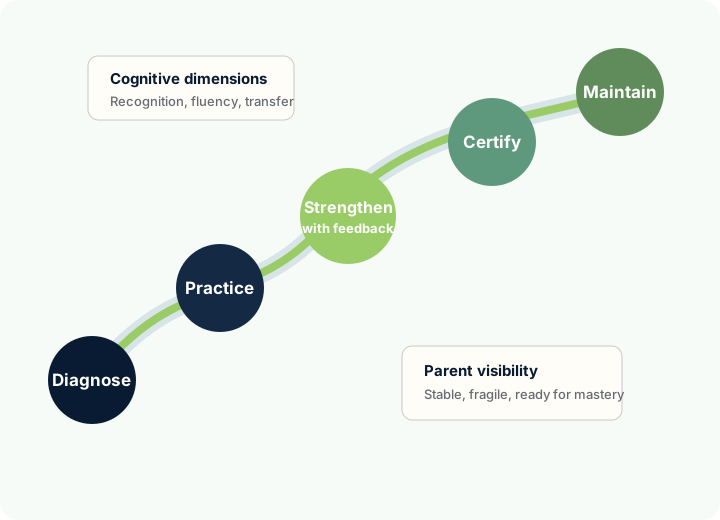
Start with math. Build durable foundations. Practice the habits behind independence.
The shift
Students can pass a lesson, copy a procedure, or get a correct answer without knowing what to do when the problem changes. Polus trains the habits behind clearer thinking and independent problem-solving.
The usual pattern
The Polus pattern
Correct answers are not always mastery. Hidden gaps should be visible and repairable.
First product
Math exposes hidden gaps quickly. When quantity, place value, fractions, operations, ratios, or early algebra are fragile, later learning becomes harder than it needs to be.
Students need to know what numbers mean before procedures can feel stable.
Addition, subtraction, multiplication, and division become easier when the structure underneath is clear.
Later math depends on relationships students can explain instead of copied steps.
Mastery Realm
Most practice asks whether a student got through the work. Mastery Realm asks what the work proves.
Trace struggle back to the foundation that needs repair.
Use hints and examples when helpful, then check independence.
Bring important ideas back before they become future gaps.
Clarity
For parents
For educators
Evidence
A student who solves independently has shown different evidence than a student who needed a hint, scaffold, or worked example. That difference should shape the next step.
Encounter a concept through explanations, examples, and representations.
Work on problems that reveal reasoning.
Use hints, feedback, and scaffolds when they help learning.
Gather proof of what the learner can do with and without support.
Move forward when the evidence supports independent understanding.
Return later so important ideas stay available.
Use the idea in new situations and unfamiliar forms.
Purpose
Polus trains people to figure things out so they can build the life they choose.
Mastery Realm is the flagship learning platform, while the broader Polus ecosystem grows through creative work, games, research tools, and simulations.
Explore Polus Products
Available now
Polus GameLab turns 18 canonical games into practical training grounds for strategy, probability, logic, information, and decision-making.
Every game includes four connected ways to explore: Play the full game, Analyze recorded decisions, Learn through guided material, and check the Rules when you need them.
A verified GameLab account is required before play and keeps progress connected across devices.
FAQ
Start here
Use the first Polus product to build stronger K-8 math foundations and clearer learning habits.
Start with Mastery Realm